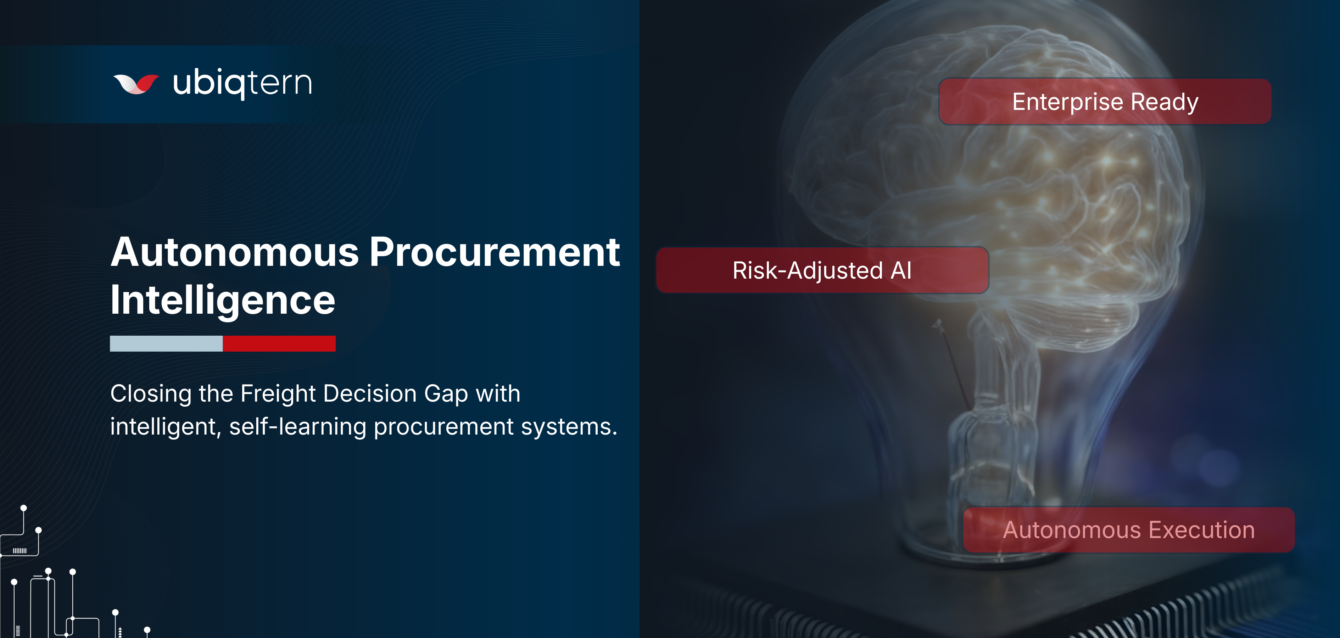
With global freight and logistics spend exceeding USD 6 trillion annually, transportation has evolved from a back-office cost center into the single largest controllable lever for enterprise margin. Yet, despite nearly 70% of enterprises modernizing their transportation systems, a persistent “Decision Gap” remains.
The challenge is structural.
Traditional procurement relies on static, deterministic models, periodic RFPs, and fixed-rate contracts, while freight markets are inherently stochastic, influenced by demand–supply imbalances, weather events, geopolitical shifts, and macroeconomic cycles. Static planning cannot keep pace with dynamic markets.
To bridge this gap, enterprises need systems that are intelligent, adaptive, and continuously learning.
From Static Systems to Autonomous Decisions
Most freight procurement platforms today are workflow-driven. They manage processes efficiently and provide rate benchmarking analytics. But they stop short of real-time decisioning.
Modern AI-based agentic frameworks change that. They can harmonize enterprise data across systems such as SAP S/4HANA, Blue Yonder TMS, and external freight intelligence networks, such as DAT Freight & Analytics. By combining internal performance metrics with real-time market signals, these systems generate risk-adjusted recommendations based on:
- Market volatility
- Current contract vs. spot spreads
- Carrier tender acceptance trends
- On-time performance
- Network capacity constraints
Agentic AI represents a paradigm shift toward Autonomous Supply Chains. According to Gartner, over 48% of enterprises are expected to integrate Agentic AI by 2028.
Autonomous Orchestration: Removing the Manual Bottleneck
To operate at enterprise scale, procurement intelligence must be platform-agnostic and deeply integrated.
Industry benchmarks show that automating repetitive procurement and data orchestration tasks can reduce administrative workload by more than 60%.
By leveraging advanced process automation engines, architected with deep expertise across SAP and Blue Yonder ecosystems, enterprises can:
- Monitor systems continuously
- Parse structured and unstructured data
- Trigger carrier communications autonomously
- Execute bid events without manual intervention
This is the foundation of the Autonomous Procurement Engine.
According to McKinsey & Company’s research on AI-enabled procurement transformation, AI-driven automation is reshaping enterprise procurement. Industry findings suggest it can reduce operational workload by up to 60% while improving speed and resilience.
Capturing the Arbitrage Gap
Industry research demonstrates that stochastic volatility and static contract lag create a persistent “Arbitrage Gap,” leading to significant opportunity to optimize freight procurement costs. When spot rates drop below contracted “protected” rates, manual teams often lack the operational velocity to capitalize on the discrepancy before the market shifts.
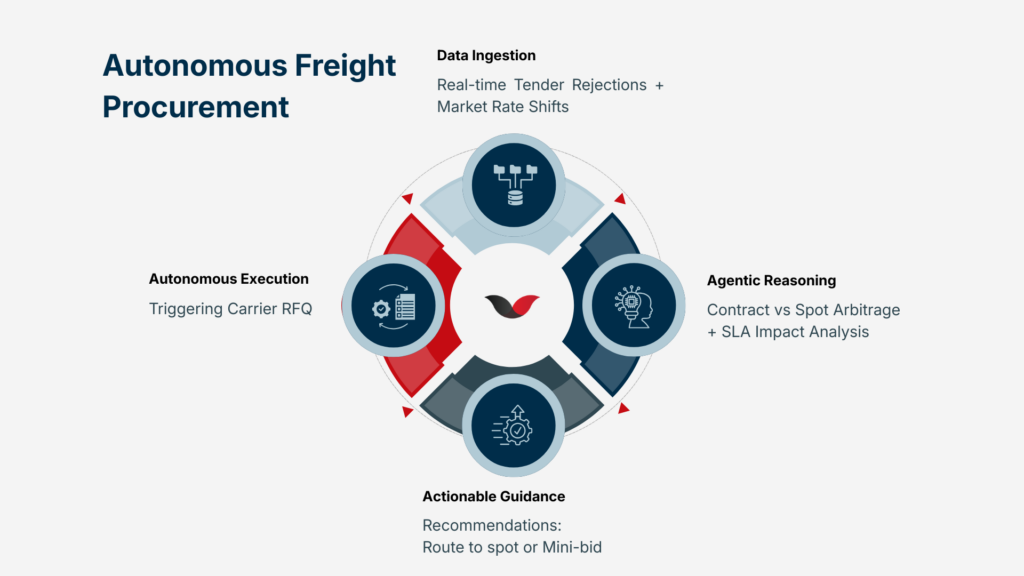
An Agentic framework resolves this through Continuous Lane Evaluation:
- Monitoring real-time tender rejections
- Tracking market rate fluctuations
- Identifying micro-procurement opportunities
- Evaluating SLA and carrier commitment impact
The system doesn’t simply detect arbitrage; it can reason through downstream risk. It understands the implications on primary carrier relationships, capacity commitments, and service performance before recommending a shift.
This transforms opportunistic savings into a structured, risk-managed strategy.
Decision Intelligence: Closing the Loop
The maturity of an AI system is measured by its ability to drive outcomes, not just insights.
By moving from ad-hoc analysis to a formal Decision Intelligence framework, enterprises can execute high-frequency procurement decisions at scale:
- Targeted Mini-Bids
Launching short-duration RFPs on volatile lanes to realign rates without disrupting the entire network.
- Dynamic Spot Shifts
Automatically transitioning freight from contract to spot markets when economic signals justify it.
- Carrier Performance Optimization
Continuously evaluating tender acceptance and on-time performance to rebalance volume toward high-performing carriers.
This closes the loop between market signal → decision → execution → performance feedback.
The Future of Autonomous Freight Procurement
The future of logistics is not just about moving freight. It is about leveraging intelligence to optimize margin while adapting to continuous market volatility.
Freight markets will remain dynamic. Macro conditions will continue to shift. Capacity cycles will persist. The competitive advantage will belong to enterprises that move from:
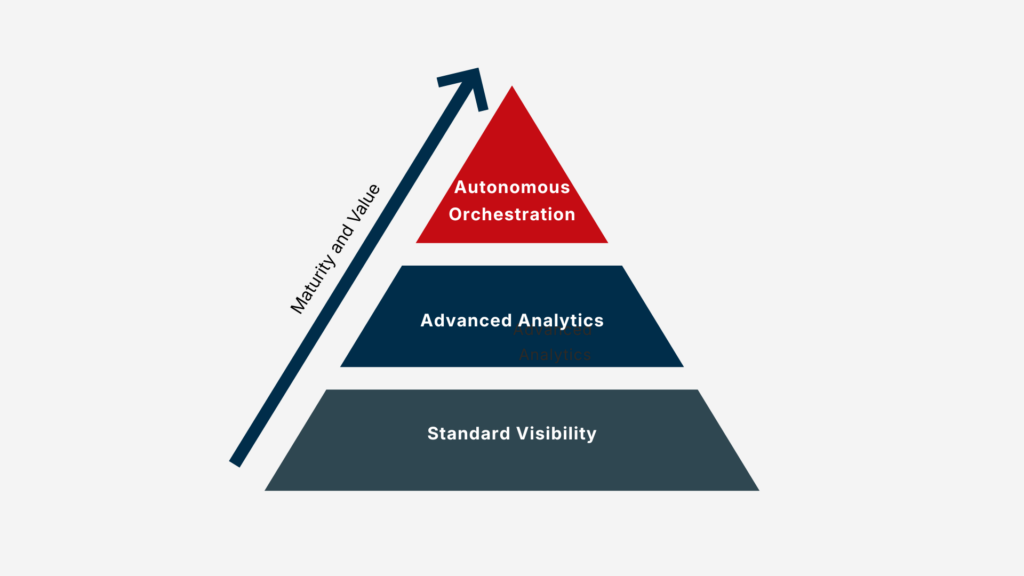
Reactive Procurement → Predictive Analytics → Autonomous Orchestration
At Ubiqtern, we are building this next-generation freight procurement platform today. Our AIFP (AI Freight Procurement) solution, powered by our proprietary Intelligent Automation platform, is enabling enterprises to transition from manual decision-making to autonomous, high-frequency procurement optimization at scale.
The $6 trillion opportunity is not just about cost savings.
It is about unlocking margin intelligence in one of the most volatile and under-optimized domains of the global economy.