

In today’s volatile environment, logistics organizations are expected to move faster, operate leaner, and remain resilient against continuous disruption.
Yet, most teams still operate reactively:
- Fix delays after they happen
- Manage costs after they rise
- Solve capacity issues when it’s already too late
What if you could predict and test decisions before executing them?
To bridge this gap between reactive operations and proactive decision-making, organizations are increasingly adopting Digital Twin technology.
What is a Digital Twin?
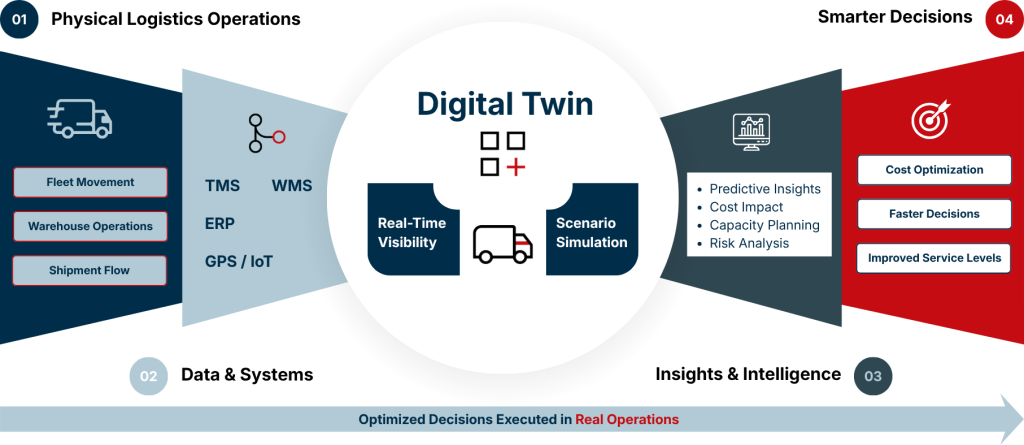
A Digital Twin is a real-time, virtual replica of your logistics operations.
It mirrors what’s happening across your supply chain from shipment movements and carrier performance to warehouse activity and network flows.
But it goes beyond visibility.
A Digital Twin brings together data from systems such as:
- Transportation Management Systems (TMS)
- Warehouse Management Systems (WMS)
- ERP platforms
- GPS tracking and IoT sensors
to create a living, dynamic model of your logistics network.
Built on continuously evolving real-time data, it enables organizations to:
- Visualize operations end-to-end
- Identify inefficiencies as they emerge
- Simulate decisions before executing them in the real world
In essence, a Digital Twin doesn’t just show you what’s happening; it helps you understand what will happen next.
From Reactive to Predictive: The Shift in Logistics Decision-Making
Traditional logistics relies on historical reporting and analyzing problems after they occur.
By then, delays have already happened, costs have increased, and opportunities to act are limited.
Digital Twin changes this. Instead of looking backward, it enables organizations to simulate future scenarios before making decisions.
This marks a shift from hindsight to foresight:
- What went wrong?
- What will happen next?
- How can we optimize it?
By testing scenarios such as demand fluctuations, fuel price changes, or carrier adjustments in a virtual environment, teams can make faster, smarter, and lower-risk decisions.
This is the real shift from reactive execution to predictive, simulation-driven logistics.
How Digital Twins Transform Logistics
Logistics systems such as Transportation Management Systems (TMS) and Warehouse Management Systems (WMS) are designed to plan and execute transportation and warehouse operations. These systems support shipment planning, load building, carrier selection, warehouse processing, and execution of deliveries to ensure efficient movement of goods.
However, execution alone is no longer sufficient in today’s dynamic logistics environment.
A Digital Twin enhances TMS and WMS by adding intelligence and simulation capabilities on top of operational planning and execution. It uses data from transportation plans, warehouse operations, shipment flows, and carrier performance to create a dynamic model of the logistics network.
By leveraging data from TMS and WMS, the Digital Twin enables simulation of transportation and warehouse scenarios, helping teams evaluate different planning strategies before execution.
This allows logistics teams to:
- Visualize shipment flows in real time
- Identify bottlenecks and underutilized capacity
- Simulate alternative strategies before execution
Instead of simply executing plans, organizations can now test, optimize, and refine decisions before they are implemented.
This shifts TMS from an execution engine to a decision intelligence platform, enabling smarter, faster, and more resilient logistics operations.
Applying Digital Twins in Logistics
Digital Twins deliver the most value when applied to real operational challenges. They enable organizations to move beyond analysis to simulate decisions, evaluate trade-offs, and optimize outcomes before execution.
Use Case 1: Demand Surges and Disruptions
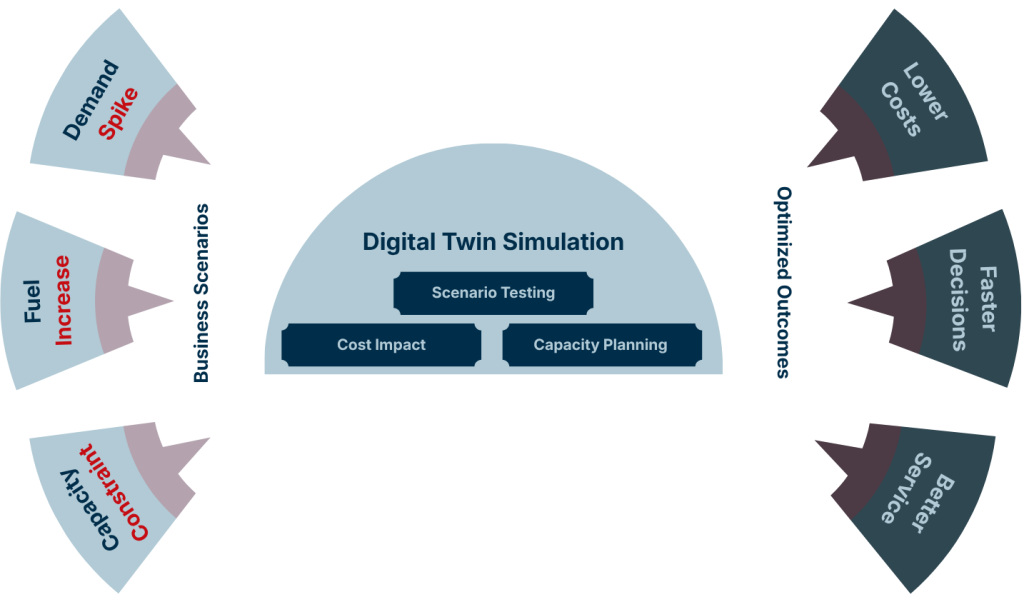
Supply chains today are highly volatile, with frequent disruptions driven by demand spikes, capacity constraints, and external risks. Digital Twin enables organizations to simulate these scenarios before they impact operations.
Teams can test:
- Sudden increases in shipment volumes
- Carrier capacity shortages
- Route disruptions or restrictions
and evaluate response strategies such as:
- Switching carriers
- Rerouting shipments
- Activating alternative distribution nodes
By identifying the most effective response in advance, organizations can respond faster, maintain service reliability, and control costs even during uncertainty.
Use Case 2: Freight Cost Optimization
Freight costs are influenced by multiple dynamic factors such as fuel prices, carrier rates, shipment volumes, and routing strategies.
In traditional setups, cost increases are often identified after execution, limiting the ability to respond. Digital Twin changes this.
By creating a virtual model of the transportation network, planners can simulate:
- Carrier reallocation
- Route optimization
- Shipment consolidation
Each scenario is evaluated as:
- Total transportation cost
- Delivery timelines
- Capacity utilization
This allows organizations to proactively select the most cost-efficient strategy by reducing spending while maintaining service levels.
The Business Impact of Digital Twins
Organizations adopting Digital Twins in logistics unlock significant advantages:
- End-to-end visibility across transportation networks
- More accurate and proactive planning
- Reduced freight costs through simulation-driven optimization
- Faster response to disruptions and operational risks
- Data-driven decision-making at scale
- Improved sustainability through optimized routing and consolidation
These capabilities enable logistics teams to move beyond execution and toward intelligent, predictive operations that deliver measurable business value.
As supply chains become more complex and unpredictable, the ability to anticipate, simulate, and optimize decisions before execution is no longer a competitive advantage; it’s a necessity.
Digital Twins empower organizations to move faster, operate smarter, and respond with confidence in an increasingly dynamic environment. If you’re exploring how to bring predictive intelligence into your logistics operations, now is the time to take the next step.
Start by rethinking how decisions are made, because the future of logistics belongs to those who can simulate it before they run it.