
The Execution Gap
Supply chains today operate in a state of constant volatility driven by demand fluctuations, capacity constraints, and increasing pressure on margins.
Over the past decade, enterprises have made significant investments in intelligent automation and AI-driven decision-making. These advancements have unlocked better visibility, improved forecasting, and more informed planning.
Despite heavy investments in TMS, WMS, and ERP systems, a fundamental limitation persists:
- 82% of organizations report their supply chains are affected by tariffs, impacting 20–40% of operations (McKinsey)
- In this new world, pre-pandemic supply chain models, based on just-in-time strategies, predictable demand, and reliable supply, are struggling to adapt. Incremental improvements aren’t enough to keep up and static processes based on backward-looking data leave companies flat-footed when disruptions hit (Blue Yonder)
System adoption and insights generated have not translated into execution efficiency. While systems have become highly effective at generating insights, they are still slower at acting on them. The gap between knowing what to do and actually doing it continues to constrain enterprise performance.
This is the execution gap. In high-frequency environments like freight and logistics, even small delays can lead to missed opportunities and major disruptions.
The Rise of Agentic AI
Over the past few years, Artificial Intelligence has rapidly evolved from machine learning and predictive analytics to Generative AI and increasingly autonomous “Agentic AI” systems.
The emergence of large language models and multimodal AI has significantly expanded the machine’s ability to understand context, generate human-like content, and interact conversationally. Agentic AI has introduced a new paradigm in which AI systems can autonomously plan, reason, coordinate tasks, use external tools, and execute multi-step workflows aligned to specific goals with minimal human intervention. These systems are increasingly being integrated into enterprise operations, digital commerce, customer service, and supply chains.
From Automation to Autonomous Execution
The next phase of supply chain evolution is not about generating better insights. It is about acting on them, autonomously, and at scale. This marks a structural shift. Systems are no longer expected to just recommend actions; they must now be capable of executing them.
Autonomous Operating Model:
From Data → Insights → Decisions → Actions → Impact

This transformation is anchored in a closed-loop operating model that unifies insights, decisions, action, and feedback. Real-time data streams are continuously analyzed, decisions are executed programmatically, and outcomes are fed back into the system to enable ongoing optimization.
AXIS – AI-based Intelligent Automation Platform
Our Intelligent Automation Architecture is designed to enable autonomous, AI-driven enterprise operations. The platform brings together enterprise systems, real-time data, integration services, process orchestration, and AI capabilities into a unified operating framework that supports scalable automation and intelligent decision-making.
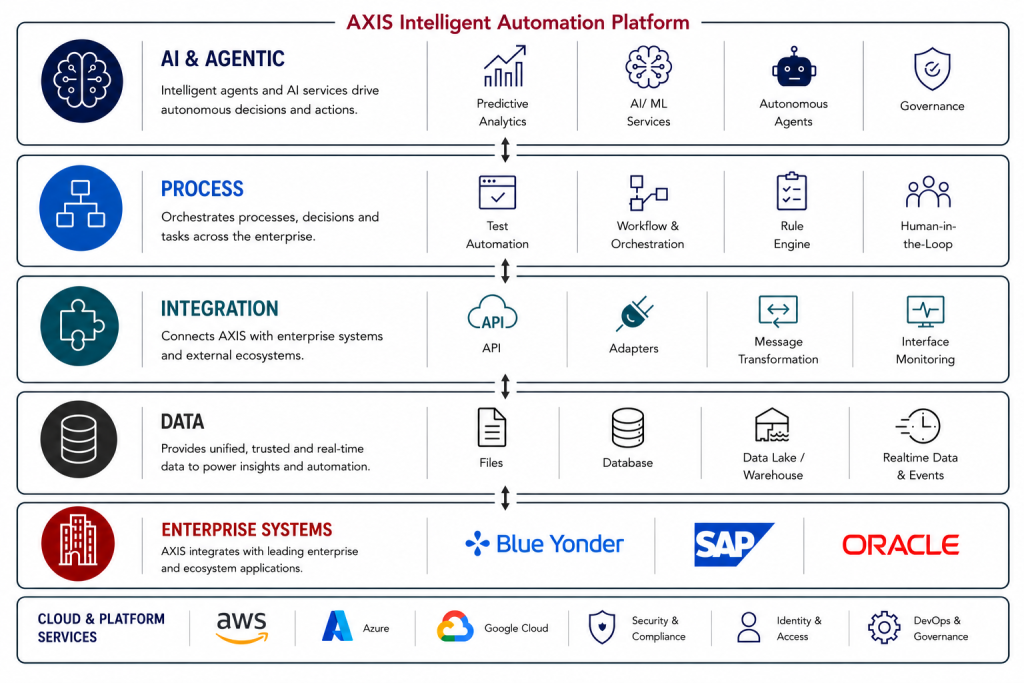
AXIS is designed and built by Enterprise Architects with decades of experience in Blue Yonder and SAP. At it’s core, AXIS combines intelligent test automation with AI-driven process automation, enabling enterprises to accelerate deployments, improve quality, and streamline end-to-end operations.
Architecture integrates core enterprise platforms such as Blue Yonder and SAP, supported by cloud-native infrastructure across AWS, Azure, and Google Cloud. The Data layer consolidates databases, data lakes, and real-time events to create a trusted digital foundation for analytics and automation.
The Integration and Process Orchestration layers enable seamless connectivity, workflow automation, exception management, and human-in-the-loop decision-making across enterprise ecosystems. On top of this foundation, the AI & Agentic layer delivers predictive analytics, AI/ML services, autonomous agents, and governance capabilities to drive proactive, intelligent, and autonomous business execution.
AXIS is designed to help organizations transition from traditional automation to fully autonomous enterprise operations with greater agility, visibility, and operational efficiency.
AXIS at Scale – AI Freight Procurement
With global freight and logistics spend exceeding USD 6 trillion annually, transportation has evolved from a back-office cost center into the single largest controllable lever for enterprise margin. Yet, despite nearly 70% of enterprises modernizing their transportation systems, a persistent “Decision Gap” remains. The challenge is structural.
Traditional procurement relies on static, deterministic models, periodic RFPs, and fixed-rate contracts, while freight markets are inherently stochastic, influenced by demand–supply imbalances, weather events, geopolitical shifts, and macroeconomic cycles. Static planning cannot keep pace with dynamic markets. To bridge this gap, enterprises need systems that are intelligent, adaptive, and continuously learning.
The AI Freight Procurement application, built on the Ubiqtern Intelligent Automation framework, resolves this through Continuous Lane Evaluation:
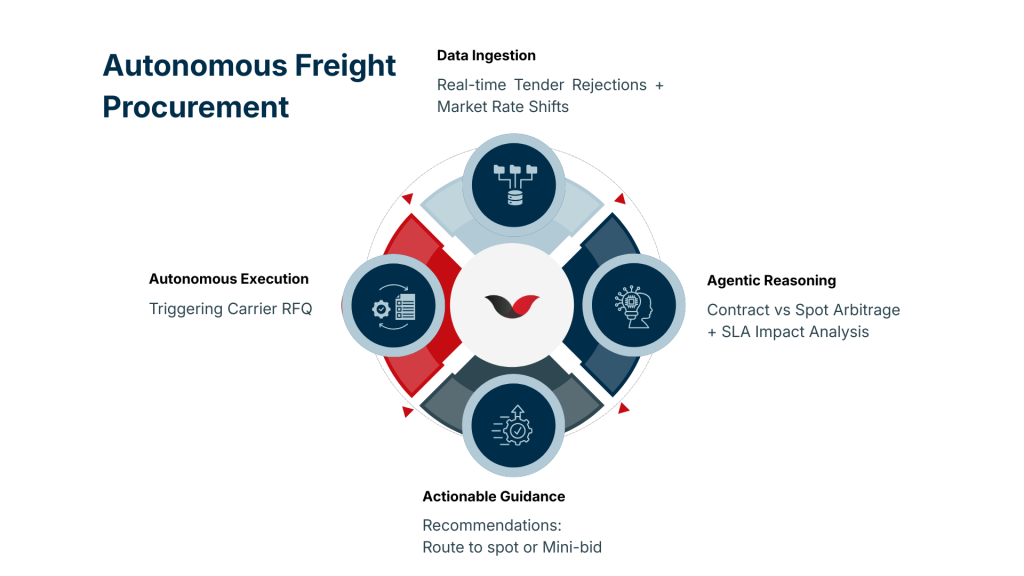
Over the last 12 months, the AI Freight Procurement Solution has generated over 20,000 recommendations with potential savings averaging over $5 mil every month. Not just recommendations, but a solution developed to analyze the actions taken and the savings generated, and to continuously learn.
The Opportunity to Win
The Intelligent Supply Chain Execution Platform serves as the execution layer across enterprise supply chain systems, enabling seamless coordination among data, decisions, and actions.
Enterprises have invested billions in supply chain systems, yet execution remains manual, fragmented, and slow.
The next wave of transformation and its opportunity to win will not come from more systems, but from Intelligent, Autonomous Execution across the Supply Chain.