

The Shift from Integration-Centric to Data-Centric Supply Chains
For years, supply chain transformation has focused on integrations; connecting systems, synchronizing applications, and enabling data exchange across increasingly complex enterprise environments.
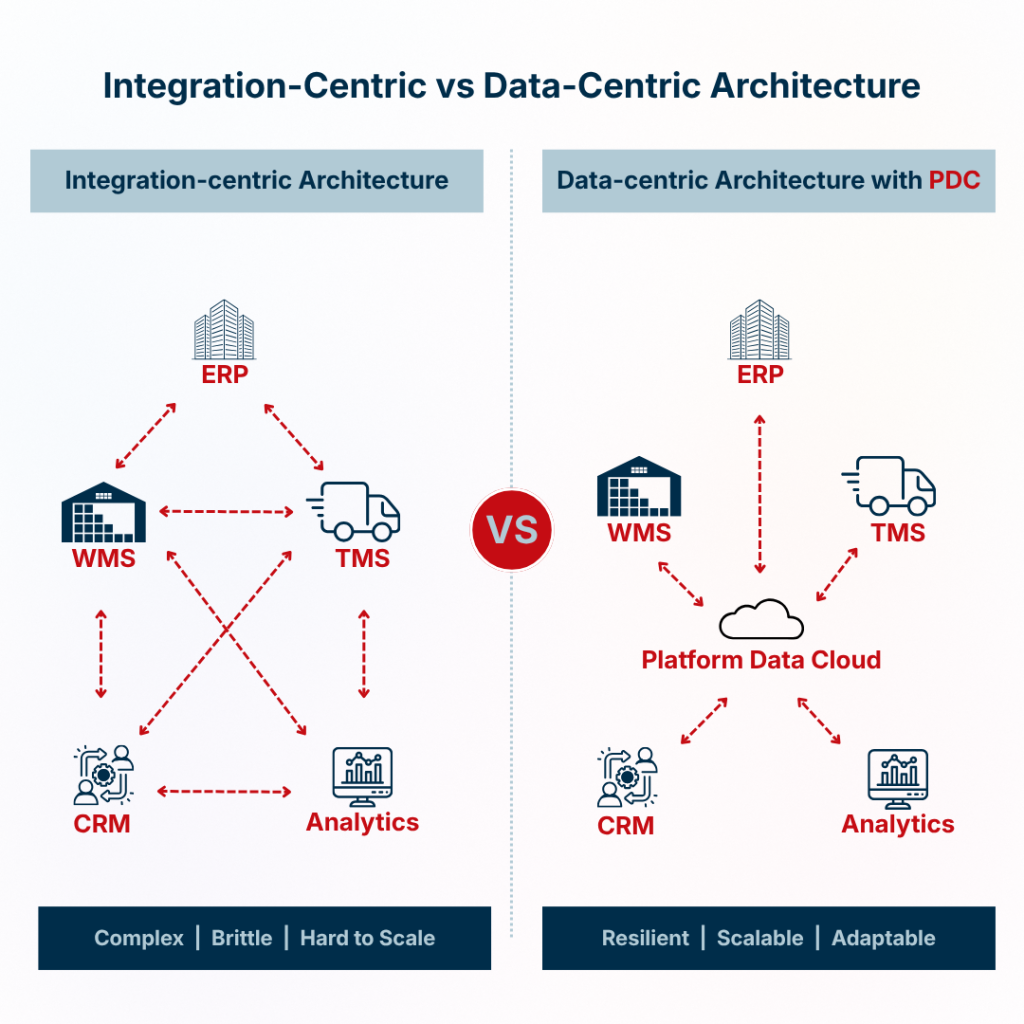
Blue Yonder’s Platform Data Cloud (PDC) introduces a fundamentally different approach to supply chain architecture, moving beyond traditional integration models toward a centralized, shared data foundation.
By enabling harmonized data orchestration across Blue Yonder applications and external enterprise systems, PDC shifts supply chains from integration-centric ecosystems to more scalable, data-centric operations.
While the shift may appear technical on the surface, its implications are far more strategic, reshaping how future supply chain ecosystems are designed, connected, and scaled
From Integration-Centric to Data-Centric Supply Chains
Traditional enterprise architectures have largely been integration-centric:
- Point-to-point APIs
- Tight synchronous dependencies
- Custom middleware orchestration
- Application-specific data handling
PDC changes that model.
Instead of applications communicating directly with each other in tightly coupled ways, systems begin operating around a shared data layer with event-driven consumption patterns.
This transition moves organizations toward:
- Standardized supply chain data models
- Asynchronous orchestration
- Reusable data services
- Scalable interoperability
In many ways, this is less about integration modernization and more about supply chain platform re-architecture.
The Reality Most Enterprises Will Face
The challenge is that most organizations are not starting from a greenfield environment.
Large enterprises already operate highly customized and integration-heavy ecosystems involving ERP platforms, legacy middleware, warehouse systems, transportation platforms, customer applications, and custom-built operational workflows.
In these environments, existing integrations are rarely reusable as-is. Organizations must rethink communication models, data harmonization, event management, monitoring frameworks, and governance strategies to align with a more event-driven, shared-data architecture.
Perhaps most importantly, legacy architectures and PDC-enabled ecosystems will likely coexist for years.
This is where many transformation programs underestimate the complexity.
The Biggest Shift Is Not Technology, It’s Mindset
One of the most overlooked aspects of PDC adoption is the operational mindset change it demands.
Traditional enterprise integrations are designed around immediate responses and deterministic transaction flows.
Event-driven architectures operate differently.
They prioritize resilience, scalability, and eventual consistency over instant synchronous processing.
That requires organizations to rethink:
- Process orchestration
- Operational monitoring
- Exception handling
- System dependencies
- Ownership of enterprise data
The transformation is as much organizational as it is technical.
Ubiqtern’s Perspective
At Ubiqtern, we view PDC as a foundational layer for the next generation of supply chain ecosystems not simply another integration platform.
The organizations that succeed will not approach PDC as a migration exercise. They will approach it as an architectural transformation initiative aligned to long-term operational strategy.
That includes:
- Early BYDM alignment and governance planning
- Phased coexistence strategies
- Integration redesign for event-driven models
- Business-process-aware modernization roadmaps
Where We See the Opportunity
The opportunity is not in forcing enterprises into large-scale rewrites overnight. It is in enabling pragmatic, incremental transformation.
Our focus areas include:
- Assessment and transformation of roadmap definition
- BYDM alignment and governance
- Event-driven integration redesign
- Accelerator and adapter frameworks for legacy coexistence
- Asynchronous orchestration support
- Monitoring and resiliency enablement
The objective is simple: reduce disruption while enabling organizations to evolve toward more scalable and intelligent supply chain architectures.
PDC has the potential to simplify and modernize supply chain ecosystems significantly. But the path to that future will not be simple. The organizations that succeed will be the ones that balance architectural ambition with practical execution. Because this is not merely an integration upgrade.
It is an architectural reset.